
















Translation of an article that originally appeared in DATZ (Die Aquarien- und Terrarien-Zeitschrift) reference: Peter Wirtz (2005) Eine neue Grundel-Krebs.Symbiose im Ostatlantik. DATZ 2005/8, 66-68.
A new goby-shrimp-association from the eastern Atlantic
By Peter
Wirtz
 Almost
130 species of gobies (family Gobiidae) from
20 different genera live in symbiosis with pistol shrimps of the genus
Alpheus. In some goby genera, like Amblyeleotris or
Cryptocentrus for instance, all known species are associated
with pistol shrimps. More than 30 different Alpheus species live with
these gobies. The shrimp digs a tunnel in the sand or gravel and continuously
keeps it clean from sediment seeping in. The goby lives in this tunnel
as a tenant. This association is advantageous for both partners. The pistol
shrimp has a weak sense of vision and uses the goby as an early warning
system. When it leaves the tunnel, it uses one of its two antennae to
maintain contact with the fish sitting at the entrance of the tunnel.
If the fish indicates danger with a tail flip or even by fleeing into
the tunnel the shrimp rapidly retreats. In German these goby species are
therefore called "guardian gobies" (Wächtergrundeln).
Almost
130 species of gobies (family Gobiidae) from
20 different genera live in symbiosis with pistol shrimps of the genus
Alpheus. In some goby genera, like Amblyeleotris or
Cryptocentrus for instance, all known species are associated
with pistol shrimps. More than 30 different Alpheus species live with
these gobies. The shrimp digs a tunnel in the sand or gravel and continuously
keeps it clean from sediment seeping in. The goby lives in this tunnel
as a tenant. This association is advantageous for both partners. The pistol
shrimp has a weak sense of vision and uses the goby as an early warning
system. When it leaves the tunnel, it uses one of its two antennae to
maintain contact with the fish sitting at the entrance of the tunnel.
If the fish indicates danger with a tail flip or even by fleeing into
the tunnel the shrimp rapidly retreats. In German these goby species are
therefore called "guardian gobies" (Wächtergrundeln).
Most pistol shrimps that have gobies as tenants live in pairs. Frequently a single goby is seen with a pistol shrimp but there are also pair-living gobies associated with Alpheus shrimps. Many of these associations are compulsory, that is goby and shrimp are always encountered together, never alone. Some of these gobies live exclusively with a certain Alpheus species, others can occupy the tunnels of various shrimp species. In the shrimp as well, some species live with a certain goby only, while others have been encountered with several different goby species.
 In
the aquarium, guardian gobies and pistol shrimps can be kept together
but usually only the gobies are sold because the shrimps are much more
difficult to catch. Experiments in aquaria have shown that some (if not
all) guardian gobies appear to be unable to dig their own tunnels and
thus need a shrimp to make a home for them.
In
the aquarium, guardian gobies and pistol shrimps can be kept together
but usually only the gobies are sold because the shrimps are much more
difficult to catch. Experiments in aquaria have shown that some (if not
all) guardian gobies appear to be unable to dig their own tunnels and
thus need a shrimp to make a home for them.
Associations of gobies with Alpheid shrimp are common in the Red Sea and
are known from the entire Indopacific. In the tropical western Atlantic,
the gobies Nes longus and Gobionellus saepepallens live
with the pistol shrimp Alpheus floridanus, occasionally also
the gobies Gobionellus stigmalophius and Bathygobius curacao.
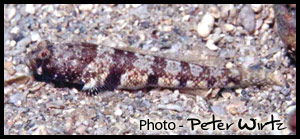
During dives at the island of Príncipe (one degree north of the equator, in front of the coast of western Africa) I have now detected the first goby-shrimp-symbiosis of the eastern Atlantic. It is quite extraordinary in many of its aspects.
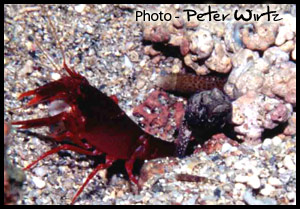
The American goby expert James van Tassell wrote me, after seeing several photos of the goby, that this is almost certainly an undescribed fish species. The Belgian crustacean expert Cédric d'Udekem d'Acoz wrote me that the shrimp associated with the goby does not belong to the genus Alpheus and not even to the family of pistol shrimps (Alpheidae), or to the true shrimps (Caridea)! It is almost certainly an undescribed species of the family of shrimp lobsters (Axiidae), which belongs to the suborder Thalassinidea.
 Apparently
a goby-shrimp association - similar to that between gobies and pistol
shrimps of the genus Alpheus in the Indopacific and in the western
Atlantic - has evolved again and completely independently in the eastern
Atlantic !
Apparently
a goby-shrimp association - similar to that between gobies and pistol
shrimps of the genus Alpheus in the Indopacific and in the western
Atlantic - has evolved again and completely independently in the eastern
Atlantic !
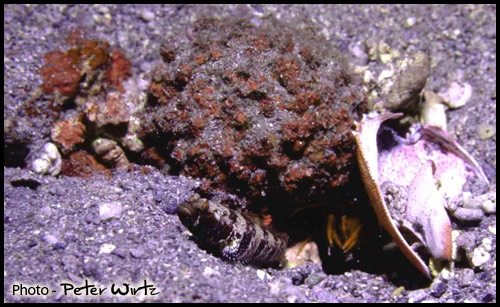
The crustacean and the goby both reach a length of 4 to 5 centimetres. They live on sandy bottoms, which contain small stones, fragments of coral and of shells. On pure sand I have never seen them but also on bottom made of larger stones with small sandy areas between them, up to the size of a hand perhaps. All of the approximately 20 associations that I have seen were in a depth range of seven to 18 m. The entrance of the tunnel is usually secured with a few small stones or shell fragments. I did not see if the tunnels have several entrances (as frequently is the case with tunnels of Alpheus). I also do not know how long and how deep the tunnels of the shrimp lobster are.
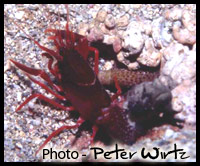
Like pistol shrimps of the genus Alpheus, the shrimp lobster frequently comes out of the tunnel, transporting sediment. In contrast to the Alpheus species, it does not maintain contact to it's fish partner with it's antennae! We do not know anything about the keenness of vision of this species. It is unlikely to be better than that of alpheids. Nevertheless, it is quite possible that the shrimp lobster does not really need the goby. The relation between the goby and the crustacean does not appear to be as tight as that between guardian gobies and their pistol shrimps. Perhaps the goby has only moved into a convenient house and does not cause any damage to the shrimp lobster. In this way, the more evolved relation between guardian gobies and pistol shrimps may have started at some time in the past. In a second step, the pistol shrimps then learned to interpret and to exploit the behaviour of the goby. Only more detailed observations of their behaviour will give more information on the relation between the goby and the shrimp lobster.
All my attempts to catch the goby and the crustacean failed! As soon as I approached them with my little aquarium net, they rapidly disappeared into the tunnel. An anesthetic that I sprayed into the tunnel also did not succeed. The tunnel was probably far too large and branched (as in Alpheus species). In the meantime, I have heard from scientists working on the symbiosis of guardian gobies and pistol shrimps how to catch these animals (but I will not reveal it here) and I am preparing the next trip to Príncipe Island. Thanks to Arthur Anker for information on symbiotic Alpheus species.
References:
Karplus, I. (1987) The association between gobiid fishes and burrowing
alpheid
shrimps. Oceanography and Marine Biology Annual Review 25, 507-562.
Karplus, I. (1992) Obligatory and facultative goby-shrimp partnerships
in the western tropical Atlantic. Symbiosis 12: 275-291
Nelson, R. (2005) The shrimp-goby chronicles:
Photos (all by Peter Wirtz)
1) The goby from Príncipe island.
2) ... as well as the crustacean are still undescribed.
3) The shrimp lobster does not maintain contact with the fish with its
antennae.
4) This magnificently coloured goby probably is a male.
For more information on this article contact the author at:
peterwirtz2004@yahoo.com
For more information on the author and his books on marine life visit
Peter
Wirtz's Website
Taxonomy Home / Shrimp-Goby Home / Explore Biodiversity Home